Most learning stops at knowledge. That's where it falls short — because applying knowledge in real situations is what makes learning stick. It's also where learners build the confidence to actually do it for real.
Here we'll explore what cognitive science says about how people actually develop the ability to apply knowledge — and how guided scenarios, powered by immersive technology, make that step possible at scale.
Where Learning Actually Pays Off
Consider these everyday situations where learning has to translate into application:
- A sales team knows the product features but struggles with when to introduce key capabilities to different stakeholders
- Healthcare professionals understand new treatment strategies but need a safe place to try them out for the first time with diverse patient cases
- Leaders learn coaching frameworks but need guidance on when to use different approaches based on team dynamics
The challenge — and opportunity — is developing the ability, and confidence, to apply what they've learned when it matters. This is where guided scenarios, grounded in cognitive science and enabled by immersive technology, help teams develop these crucial skills.
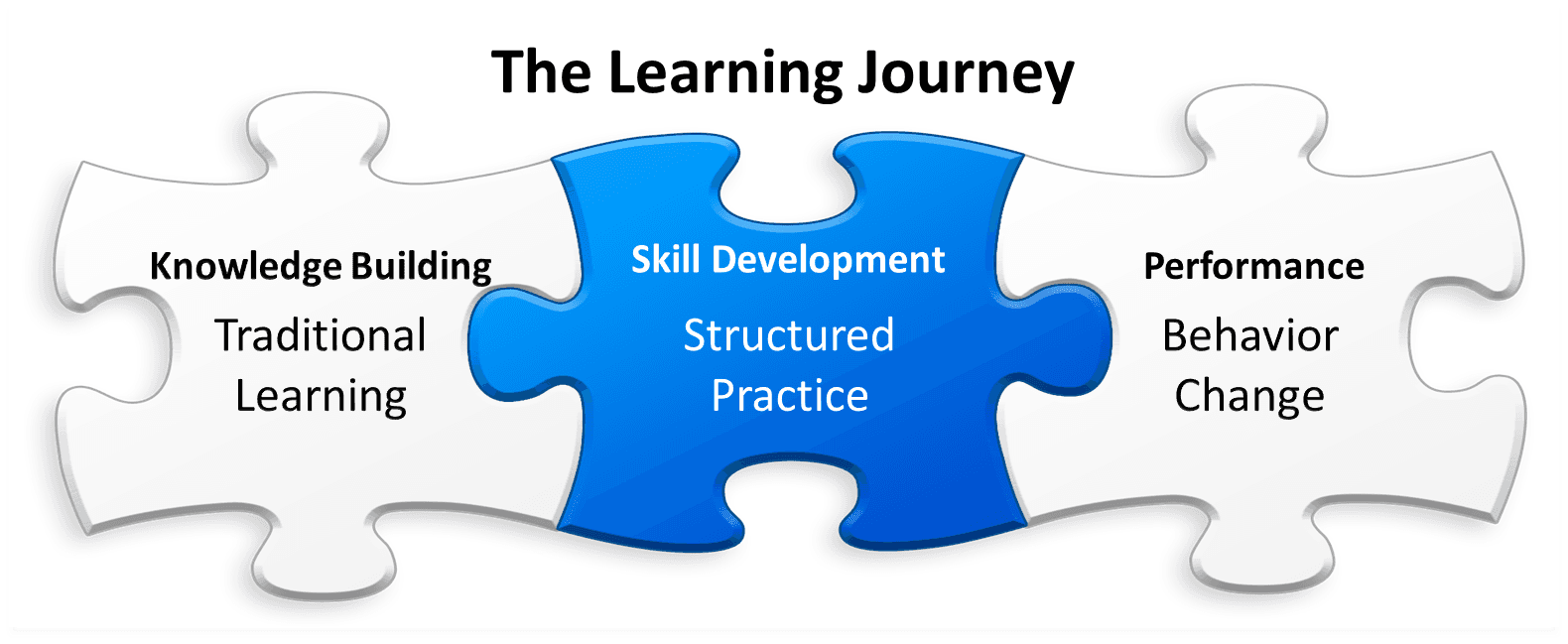
The Learning-Performance Gap
Research across multiple fields — from medicine to aviation to corporate leadership — shows a consistent pattern: knowledge alone doesn't create behavior change. To transform performance, we need to understand how people actually develop the ability to apply knowledge in real situations.
CASE STUDY: Medical Education Evolution
Medical schools faced a critical challenge decades ago: students wanted more clinical practice, but there weren't enough clinical mentors to go around. The solution? Guided scenarios through simulation where students make diagnostic and treatment decisions in safe environments. Today, medical simulation is a cornerstone of clinical education, allowing students to develop and refine their clinical judgment before treating actual patients.
Four Cognitive Science Principles That Make Learning Stick
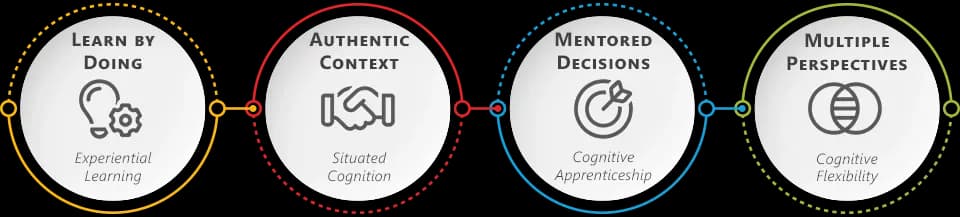
1. Learning by Doing (Experiential Learning)
The most fundamental principle of skill development is active engagement — putting knowledge to work in realistic situations. But not all approaches are equally effective.
What the Research Shows:
- Expert guidance during application accelerates skill development
- Learning must extend into realistic application, not just knowledge transfer
- Immediate feedback on decisions helps develop expert judgment
REAL-WORLD EXAMPLE. Consider how pharmaceutical sales managers develop their teams. Understanding coaching principles isn't enough. Effective development requires applying those principles in real situations: When should they intervene with a rep? Which coaching approach fits different situations? What sequence of development activities will be most effective? Through guided scenarios, managers build the confidence and judgment to apply coaching principles in real situations.
2. Authentic Contexts Matter (Situated Cognition)
When learning environments reflect the complexity of real-world situations, what's learned transfers more effectively to the job.
Key Research Insights:
- Context helps learners recognize when to apply different approaches
- Safe practice environments encourage learners to try, make mistakes, and learn
- Multiple contexts build robust, transferable skills
PRACTICAL APPLICATION. A global technology company needed to improve complex solution selling. Instead of traditional sales training, they implemented guided scenarios in interactive learning environments focused on real-world decisions: How to sequence stakeholder engagement? When to introduce technical experts? Which business challenges to prioritize? Through guided scenarios, sales teams built the confidence and judgment to apply what they learned across complex selling situations.
3. Making Expert Thinking Visible (Cognitive Apprenticeship)
One of the most powerful learning approaches is understanding how experts in your organization actually apply their knowledge in the moment. The challenge? Their thinking process is largely invisible.
The Hidden Decision Challenge:
- Experienced people often can't articulate their thinking process
- Their judgment follows patterns developed through experience
- Simply observing their success doesn't reveal their underlying mental models
REAL-WORLD EXAMPLE. Clinical diagnosis demonstrates this principle perfectly. Experienced clinicians don't just know more medical facts — they recognize complex patterns and make nuanced decisions about when to apply different approaches. Through simulation-based guided scenarios with expert feedback, medical residents learn to recognize these same patterns, developing their clinical judgment over time.
4. Multiple Perspectives Build Robust Skills (Cognitive Flexibility)
Experiencing different situations helps learners develop flexible, adaptable expertise.
Why This Matters:
- Real situations rarely match training examples exactly
- Learners need to recognize patterns across contexts
- Applying knowledge well requires adapting to new situations
PRACTICAL APPLICATION. Leadership development illustrates this principle well. A leader might understand a coaching framework, but knowing when to be directive versus collaborative requires judgment developed through application. Through interactive learning scenarios, leaders experience multiple situations with different team dynamics, building the confidence to apply their coaching skills across different team situations.
Putting It All Together
When these four cognitive science principles combine within immersive simulations powered by guided scenarios, the results are powerful:
- Learners build the confidence and judgment to apply knowledge in real situations
- Decision-making becomes more confident and nuanced
- Skills transfer effectively to real-world situations
- Performance improvements can be measured and tracked
Building Confidence to Apply Across Your Team

1. Focus on Application
- Move beyond knowledge to actually applying it
- Create safe practice environments through simulation
- Build judgment through structured feedback

2. Build Pattern Recognition
- Capture real-world situations in interactive scenarios
- Expose learners to multiple perspectives
- Make expert thinking visible and sharable

3. Measure Impact
- Track decision-making improvements
- Monitor skill development
- Assess real-world performance changes
Looking Ahead
In Part 2 of this series, we'll explore how to create the authentic situations where applying knowledge actually pays off. You'll see how guided scenarios and immersive technology work together to develop the confidence and ability to apply knowledge that drives lasting performance.
References
- Kolb D. Experiential Learning: Experience as the Source of Learning and Development. Prentice Hall, Upper Saddle River, NJ. 1984.
- Motola I, Devine LA, Chung HS, Sullivan JE, Issenberg SB. Simulation in healthcare education: a best evidence practical guide. AMEE Guide No. 82. Med Teach. 2013 Oct; 35(10):e1511-30.
- Collins A, Brown JS, Holum A. Cognitive apprenticeship: making thinking visible. American Educator 15.3 (1991): 6-11.
- Spiro RJ, et al. Cognitive Flexibility Theory: hypermedia for complex learning, adaptive knowledge application, and experience acceleration. Educational Technology 43.5 (2003): 5-10.