Have you ever wondered why experts know what to do in new situations? The secret lies in their mental models — the sophisticated frameworks they use to understand situations and choose optimal approaches. These aren't just simple decision trees or memorized processes. They're rich, dynamic ways of seeing the world that transform how people recognize patterns and make decisions.
Here we'll explore how cognitive science and guided scenarios, powered by immersive technology, help all of your team develop stronger mental models that move closer to how experts think. We'll show you how to capture the expert's mental models and share them at scale to drive better learning outcomes.
Barriers to Mental Model Change
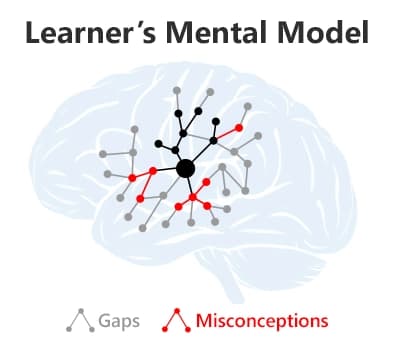
Think about situations where a team member struggles to adopt a new approach. When learners' mental models have gaps or misconceptions, two critical barriers emerge.
Gaps
When learners' mental models have gaps, they miss important connections experts see naturally. They struggle to apply new approaches confidently and can't adapt effectively to different situations.
Misconceptions
When misconceptions exist, learners often resist new approaches that conflict with their current understanding, applying knowledge inappropriately or falling back on familiar but suboptimal approaches.
Impact of Barriers on Skill Development
Let's explore why improving how learners apply knowledge isn't as straightforward as traditional instructional approaches. Many learning designs treat skill development like knowledge transfer — presenting expert thinking, explaining what should be done, then testing application.
Consider these examples: sales teams learning complex stakeholder management, physicians adapting treatment strategies for complicated cases, or leaders developing nuanced coaching approaches.
In these situations, treating skill development like knowledge transfer doesn't work. Why? Because we're trying to force an expert's fully-developed mental models onto learners whose current understanding has gaps and misconceptions.
These barriers prevent learners from evolving their mental models. The result: no change in behavior.
A Fundamental Shift in Approach
This insight transforms how we think about developing learners: Instead of pushing subject matter expert mental models onto learners, we need to start with their current understanding — their mental model — and help them develop systematically.
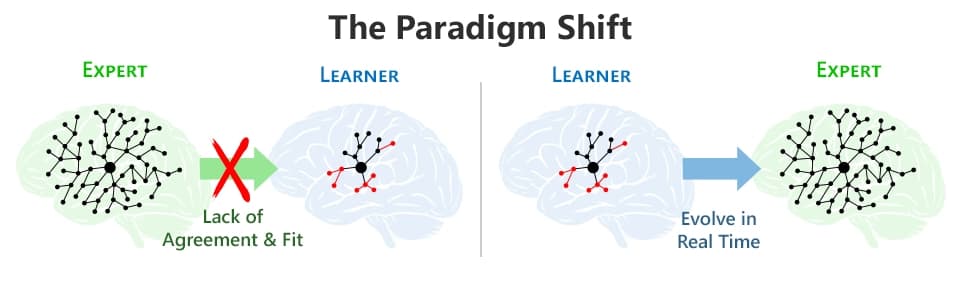
Think about how great mentors and coaches actually work. They don't just tell people what to do — they understand where their learners are starting from, put them in situations that reveal gaps in thinking, provide feedback that helps evolve their mental model, and guide them toward more sophisticated understanding.
This is why guided scenarios are so effective — they naturally build from the learner's mental model rather than forcing expert models on them. But how do we systematize and scale this approach?
A Systematic Solution: The Mental Model Learning Framework™
Through years of research and practical application, we've developed a systematic framework that captures how great coaches and mentors develop mental models in others. By combining this framework with immersive learning technology, we can now extract and scale expert wisdom from any subject matter expert — whether they're natural coaches or not — making proven development approaches accessible across all domains.
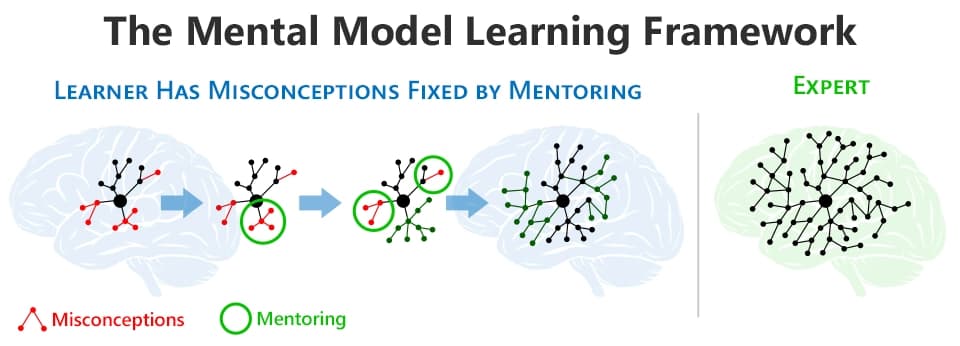
The framework consists of four integrated steps that align with how learners actually develop expertise. At its core is a fundamental principle: start with the learner's mental model rather than imposing the expert's model.
1. Understanding the Real Gap
Organizations tend to focus only on identifying optimal behaviors that aren't happening but should be, then telling people what to do differently. This reflects just the expert's mental model. The next critical step is discovering: What are people doing now? Their current actions reflect how they're thinking — their current mental models. Once we understand that, we have the real gap: what they're doing now versus what they should be doing instead.
2. Creating Authentic Decision Points
The gap itself reveals our decision points: current mental models leading to certain approaches, optimal ones leading to stronger mental models. With help from subject matter experts (SMEs), coaches, and experienced people, you can identify specific situations where these gaps occur. This creates authentic scenarios that reflect real decision-making opportunities while revealing pathways to stronger mental models.
3. Developing Transformative Feedback
While SMEs readily share what should be done and why, that's not enough. The crucial insight comes from understanding why current approaches fall short and — most importantly — capturing the coaching wisdom that helps learners understand why. This is where nuance matters most: it's rarely about right or wrong, but about understanding subtle differences in thinking that lead to better outcomes.
4. Measure Decision-Making
Unlike traditional assessments that test knowledge recall, we track how learners' decision-making evolves — where they needed guidance, how their pattern recognition improves, and when they begin selecting optimal approaches. Through guided scenarios embedded in simulation technology, we can capture thousands of decisions and provide insights into how mental models develop over time.
Scaling Through Immersive Technology
Live coaching with expert mentors has always been the gold standard for developing expertise. The challenge? You can't clone your best coaches. Immersive simulation technology makes it possible to deliver the Mental Model Learning Framework consistently across organizations.
Learners engage with realistic scenarios that develop their decision-making, receiving the same kind of nuanced feedback great coaches provide. The technology enables safe practice while measuring how mental models evolve over time.
Organizations can now complete the learning journey at scale — helping every learner move from knowledge to confidently applying it in the situations they'll actually face.
Bringing It All Together
Through this series, we've explored how guided scenarios help learning actually stick — and translate into action. From cognitive apprenticeship to cognitive flexibility, from authentic situations to mental models, these principles explain why completing the learning journey — applying knowledge in realistic situations with expert guidance — is what makes learning actually stick.
Most learning stops at knowledge. With guided scenarios, it doesn't have to. By capturing how experts think and how great coaches develop others, you can now help everyone on your team build the confidence and judgment to apply what they've learned — at scale, and for real.
References
- Spiro RJ, et al. Cognitive Flexibility Theory: hypermedia for complex learning, adaptive knowledge application, and experience acceleration. Educational Technology 43.5 (2003): 5-10.
- Collins A, Brown JS, Holum A. Cognitive apprenticeship: making thinking visible. American Educator 15.3 (1991): 6-11.
- Ericsson KA. Deliberate practice and acquisition of expert performance. Academic Emergency Medicine 15 (2008): 988-994.